September 14, 2026
CDS History
Read More
.avif)
Rhoncus amet integer viverra pretium pharetra ac eget varius massa vestibulum massa facilisi in arcu quam pharetra massa maecenas venenatis scelerisque massa et massa.
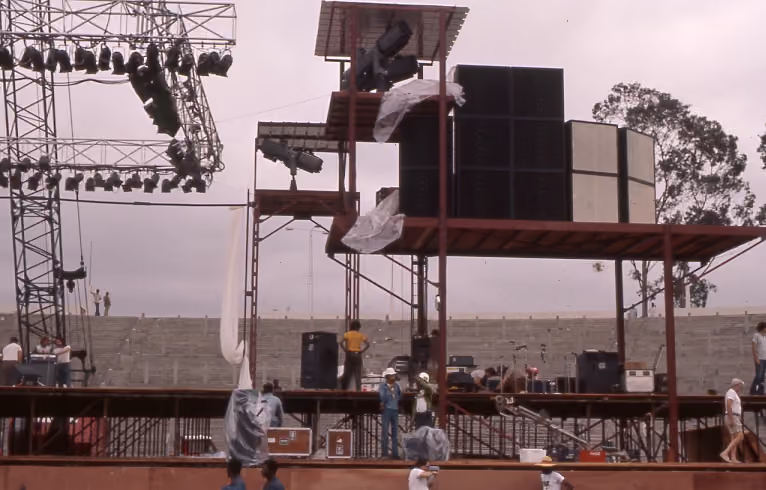
In 1974, Muhammad Ali and George Foreman were scheduled to meet in Kinshasa, Zaire (now the Democratic Republic of Congo) for what Ali dubbed "The Rumble in the Jungle." To coincide with the landmark fight, South African musician Hugh Masekela and American record producer Stewart Levine devised a three-day music festival featuring a mix of African artists and American performers including James Brown, B.B. King, and Bill Withers. While an injury to Foreman postponed the fight, Zaire '74 went ahead on September 22–24, 1974.
Clair was hired as the event's sound company thanks to a pre-existing relationship with Philadelphia-based lighting director Bill McManus. Engineers Bill Darlington, Trip Khalaf, and David Hendel were assigned to the gig. The week before the event, Darlington and Khalaf transported equipment from Lititz to Egotrips, Inc. in New York, where it was sent to Africa via air freight. Hendel, then working with Crosby, Stills, Nash & Young in London, would meet them in Kinshasa.
When Hendel arrived, he had no information about the crew's whereabouts. Unable to speak French, he was overheard talking about a concert in English and put in a cab to a nearby hotel. The next day, he wandered Kinshasa until a local pointed out that he was quartered at Foreman's hotel. The rest of the crew were at the Intercontinental Hotel with Ali's team.
By the time Hendel located Darlington and Khalaf, they had finished loading in with the help of union workers from the Capitol Center in Washington, D.C. The venue required structural support, and locals worked hard to reinforce it with concrete. The sound system consisted primarily of Clair S-4 loudspeakers, which had debuted only months prior. The speakers were stacked on platforms of ¾-inch mahogany plywood—the only wood available locally.
By that time, the fight had been postponed. It was decided the festival would continue but was delayed by one day.
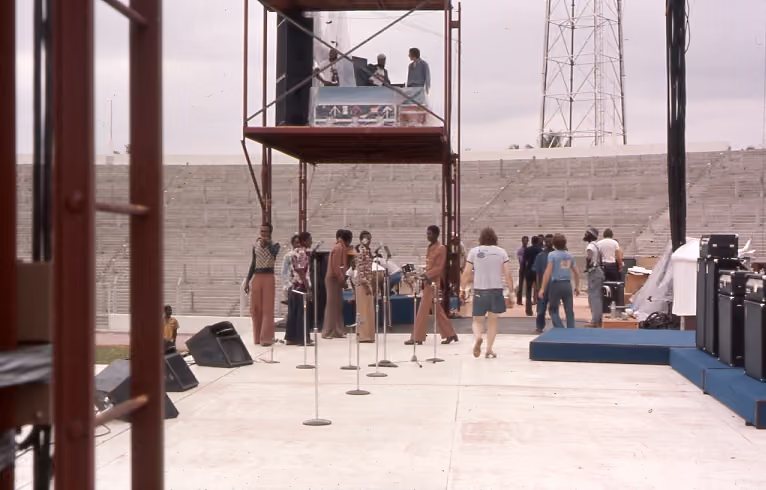
Hendel recalls the event being a lot of work, citing constant rehearsals. The engineers had to devise methods for miking traditional African instruments, like log drums. During Day 2, workers shut off the venue's main water supply to troubleshoot a leak—the same water supply cooling the equipment generators. The generators inevitably overheated and shut down. When the backup generators were started, an issue left only half the PA functioning. The speakers from the working half were reangled to compensate for the deficiency.
During the event, the political climate was sensitive, prompting safety concerns. A film crew encountered difficulties with military personnel while filming, which heightened the crew's caution. After the final performance, the load-out was rushed, and Khalaf recalled personally forklifting equipment to ensure their swift departure.
Zaire '74 recently celebrated its fiftieth anniversary and the cultural and historical milestone looms large as part of Clair's legacy. Despite many unique challenges, Zaire '74 resulted in some truly memorable performances thanks to a dedicated team of problem solvers.
.avif)